
 EN
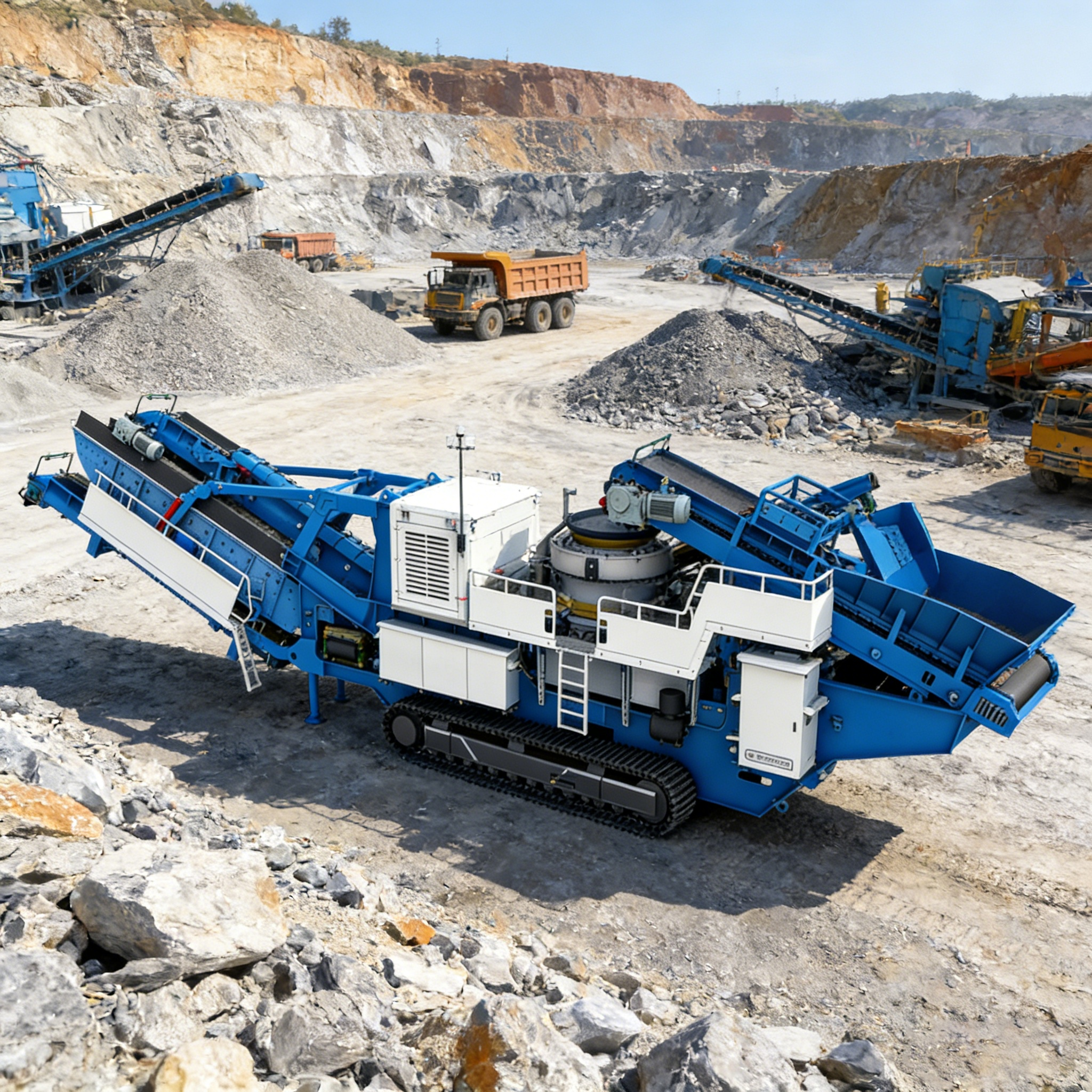
Hard Rock Crusher Plant Design: Processing Granite and Basalt under Extreme Abrasion
Key Takeaway: Processing highly abrasive igneous rocks like granite and basalt (Mohs 6–7, silica content 65%) requires a compression-based multi-stage crushing circuit to control wear costs. Standard impact crushers must be avoided for primary and secondary stages; instead, plant designers should pair heavy-duty jaw crushers with high-eccentricity cone crushers and vertical shaft impact (VSI) shapers to sustain aggregate flakiness below 12% while maintaining liner lifespans.
⚖️ Geological Physics: Why Granite and Basalt Accelerate Metal Loss
The wear dynamics in a stone crushing plant are governed by the mineralogical composition and compressive strength of the feed material. Standard plant configurations optimized for soft sedimentary rocks like limestone will fail catastrophically when introduced to granite or basalt.
Granite Properties: Composed of interlocking quartz (Mohs hardness 7) and feldspar crystals. When crushed, these crystals do not shear smoothly; they fracture into extremely sharp, angular fragments that gouge steel surfaces, accelerating cutting wear.
Basalt Properties: A dense, fine-grained volcanic rock with compressive strengths often exceeding 300 MPa. Its high density demands immense mechanical force to initiate tensile fracture, placing extreme mechanical stress on crusher eccentric shafts and mainframes.
The Wear Cost Impact: Processing these materials increases friction and heat at the crushing face. Standard manganese steel liners in a poorly configured circuit experience a 40% to 60% reduction in wear life compared to limestone processing, turning liner replacement costs into a primary bottleneck for plant profitability.
?️ Three-Stage Hard Rock Circuit Configuration and Parameter Control
To process large run-of-mine (ROM) granite or basalt boulders into high-quality cubical aggregates, a dedicated three-stage reduction process must be implemented.
Primary Stage: Heavy-Duty Compression (Feed size 1.5 m down to 150–250 mm)
Only heavy-duty jaw crushers or primary gyratory crushers can handle the initial reduction of high-compressive-strength igneous rocks.
For ROM feed up to 1.5 meters, a jaw crusher with a minimum feed opening of 1.1 meters is required. The Closed Side Setting (CSS) must be maintained between 150 mm and 200 mm, limiting the reduction ratio to a conservative 4:1 or 6:1 to prevent excessive lateral load on the toggle plate.
A heavy-duty vibrating grizzly feeder must be positioned upstream to scalp out natural fines below 100 mm, bypassing the jaw to prevent packing and reduce power consumption by up to 30%.
Secondary Stage: Layer-Compression Cone Crushing (Reduction to 20–40 mm)
Secondary reduction of hard rock must rely on high-eccentricity cone crushers utilizing the laminating (layer-compression) crushing principle. In this stage, material is crushed by compressed contact between rock particles rather than relying on impact with the mantle.
The eccentric throw must be set to a high configuration to deliver powerful, high-force compression strokes. A recirculating vibrating screen must be integrated into a closed loop with the secondary cone, returning oversized material above 40 mm to prevent over-crushing and minimize the generation of unusable micro-fines.
Tertiary Stage: Vertical Shaft Impact (VSI) Shaping (Final sand and cubicity)
For high-performance concrete aggregate specifications (such as ASTM C33 or EN 13043), the flakiness index of the final product must remain below 12%. Cone crushers alone cannot guarantee this cubicity.
A VSI shoper operating on a rock-on-rock (stone dust bed) configuration must be utilized for the tertiary stage. The high-speed rotor flings aggregate particles against a stationary rock pocket, fracturing weak, elongated grains along natural mineral cleavage lines and rounding sharp edges. Since the primary impact occurs rock-on-rock, wear costs are kept low despite the high abrasiveness of the granite or basalt feed.
⚙️ Materials Engineering: Selecting the Correct Liner Metallurgy
Selecting the correct alloy for crushing liners is a delicate balance between abrasive wear resistance and impact fracture toughness.
| Wear Zone | Recommended Alloy Grade | Core Mechanical Mechanism | Failure Risk to Avoid |
|---|---|---|---|
| Primary Jaw Plates | 14% to 18% Manganese (Mn18Cr2) | Rapid work hardening under heavy compressive impact from 200 HB to over 500 HB. | Chasing peak hardness; brittle fracture if the alloy lacks ductile core toughness. |
| Secondary Cone Liners | High-Manganese (Mn18 or Mn22) | High-eccentricity compression hardens the face continuously while maintaining high impact resistance. | Severe localized grooving if feed contains high clay or uncrushable tramp metal. |
| VSI Rotor Tips | Tungsten Carbide Inserts (Grade K) | Extreme hardness (HV1500) resists sliding abrasion from high-velocity mineral sand. | Direct steel impact; thermal shock cracking from dry run conditions. |
The Basalt Paradox
A common mistake among plant operators is choosing the hardest available alloy (such as high-chromium white irons or carbide-insert composites) for primary jaw plates in basalt quarries.
While these materials resist abrasion, they lack the impact toughness required to survive the massive shock loads of primary reduction. Under 300 MPa impact, high-hardness brittle alloys develop microscopic tension cracks, leading to catastrophic spalling or structural splitting of the jaw plate. For primary stages, manganese steel remains the only safe engineering standard.
?? Field Case Study: Resolving Extreme Wear and Poor Cubicity in a Basalt Quarry
A commercial aggregates producer in Georgia operating a 300 t/h crushing plant for basalt road-base aggregate experienced severe financial losses due to underperforming equipment.
The plant layout utilized a primary jaw crusher followed by a horizontal shaft impact (HSI) crusher for secondary reduction.
The Diagnosis
Extreme Wear Costs: Because basalt is highly abrasive, the secondary HSI impact blow bars were wearing down completely every 48 operating hours, requiring bi-weekly shutdowns and costing over $18,000 per month in wear parts alone.
Poor Product Quality: Attempting to run the HSI with worn blow bars resulted in a flakiness index exceeding 24%, failing the local department of transportation (DOT) concrete sand standards.
The Engineering Rectification
The plant underwent a complete retrofitting process designed by our geological and mechanical team:
Replaced the HSI: The high-wear secondary HSI was completely replaced with a high-eccentricity secondary cone crusher featuring Mn18Cr2 manganese liners.
Added VSI Shaping: A 200 kW rock-on-rock VSI shaper was installed as a tertiary stage, running in a closed loop with a high-frequency screening deck.
Installed pre-scalping: An independent double-deck vibrating screen was installed before the secondary stage to divert fines below 20 mm directly to the VSI, reducing the secondary cone's recirculating load.
The Results
Following the retrofitting campaign, the average liner replacement interval for the secondary stage extended from 48 hours to 650 operating hours, reducing wear-part operating expenses by 78%.
The final product's flakiness index dropped from 24% to a consistent 9.5%, fully complying with premium concrete aggregate specifications and opening up high-margin municipal highway supply contracts.
? Rock-Crushing Engineering & Selection Checklist
Before finalizing the procurement of equipment or designing the layout of a hard rock crushing plant, engineering directors must verify compliance with the following:
| Design Parameter | Minimum Hard Rock Specification | Engineering Verification Method |
|---|---|---|
| Primary Reduction Ratio | Restricted to a maximum of 4:1 to 6:1 | Calculate ratio of maximum feed dimension to primary jaw CSS setting. |
| Tramp Iron Relief | Hydraulic dual-acting release cylinders on cone crushers | Confirm presence of automatic hydraulic clearing and un-blocking systems. |
| VSI Feeding System | Bi-flow system capable of cascading feed | Inspect the feed hopper design for adjustable cascade gates. |
| Dust Mitigation | High-pressure water misting or dry baghouse filtration | Confirm compliance with OSHA regional dust control regulations. |
Table of Contents
-
Hard Rock Crusher Plant Design: Processing Granite and Basalt under Extreme Abrasion
- ⚖️ Geological Physics: Why Granite and Basalt Accelerate Metal Loss
- ?️ Three-Stage Hard Rock Circuit Configuration and Parameter Control
- ⚙️ Materials Engineering: Selecting the Correct Liner Metallurgy
- ?? Field Case Study: Resolving Extreme Wear and Poor Cubicity in a Basalt Quarry
- ? Rock-Crushing Engineering & Selection Checklist