
 EN
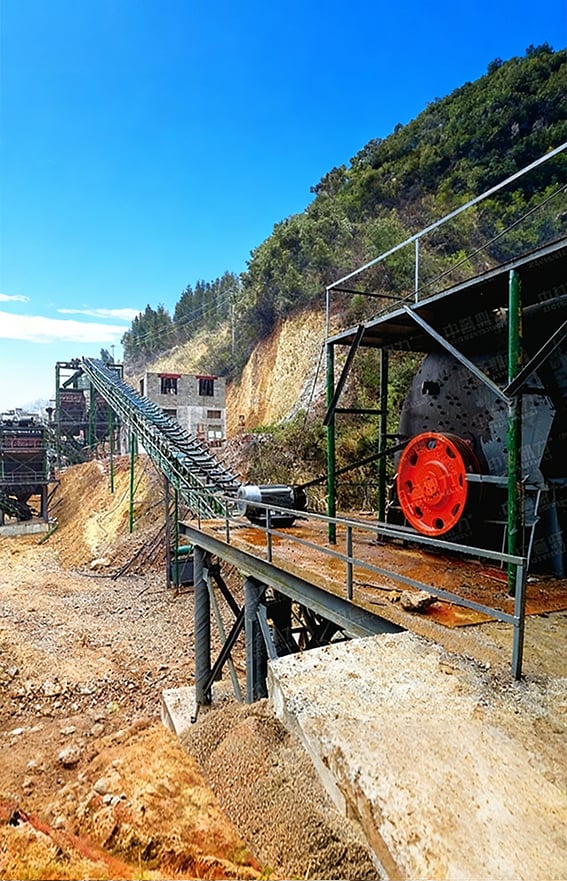
Crushing and Grinding: The Foundation of a Rock Gold Mining Production Line
Primary and Secondary Crushing for Hard Rock Gold Ore
Hard rock gold ore rarely yields recoverable gold directly from run-of-mine material. A gold mining production line therefore begins with staged size reduction: primary crushing—typically using a jaw crusher—reduces boulders exceeding 500 mm to roughly 100–150 mm. Secondary crushing, commonly performed with cone crushers or high-pressure grinding rolls (HPGRs), further reduces feed to 20–50 mm. This two-stage approach lowers downstream grinding energy demand and enhances mineral surface exposure for subsequent liberation. Closed-circuit screening ensures oversized particles are recirculated, stabilizing mill feed size and improving circuit efficiency. In competent granite or quartz-hosted deposits, the crushing circuit may consume 30–50% of total plant power (industry survey, 2022). Jaw crushers routinely accept feed up to 1,000 mm and handle compressive strengths above 250 MPa—but wear liners and toggle seats require frequent inspection due to accelerated metal loss in abrasive hard rock. Automated gap control and vibration monitoring help maintain consistent crusher output. Operators adjust closed-side settings based on real-time ore hardness and moisture to sustain throughput and narrow product size distribution—critical for avoiding overgrinding and maximizing recovery in downstream gravity or flotation stages.
Grinding Optimization: SAG/Ball Mills vs. Dry Grinding in the Gold Mining Production Line
Grinding liberates fine gold particles after crushing. Semi-autogenous grinding (SAG) mills typically serve as primary grinders, followed by ball mills for finish grinding. Wet grinding is standard: water enables efficient classification, suppresses dust, and mitigates heat buildup. Dry grinding is reserved for arid regions but incurs 10–25% higher energy demand and introduces significant dust-control challenges. Wet SAG/ball circuits reliably produce a P80 of 75–150 µm—the particle size at which 80% of the material passes through a sieve—while dry systems require air classification and rigorous thermal management to approach similar fineness. Energy data from 2021 indicate wet grinding can reduce power consumption by up to 15% versus equivalent dry circuits. Wet circuits also support higher throughput and lower liner wear when ore hardness exceeds 180 MPa. Ultimately, the choice hinges on water availability, ore hardness, and compatibility with downstream leaching chemistry. A well-designed grinding circuit stabilizes particle size distribution, prevents bottlenecks, and protects overall plant metallurgical performance.
Mineral Liberation and Physical Separation in the Gold Mining Production Line
After crushing and grinding, physical separation exploits differences in density and surface chemistry. Gravity concentration and flotation are the dominant routes—selection depends on gold liberation size, sulfide content, and downstream process economics.
Gravity Concentration for Free-Milling Gold: Jigs and Centrifugal Concentrators
Gold’s high specific gravity (~19.3) contrasts sharply with common gangue minerals like quartz and feldspar (2.6–2.7), enabling effective gravity separation. Jigs use pulsed water flow to stratify heavy gold particles; centrifugal concentrators apply high g-forces to recover fine free gold that would otherwise bypass jigs. These units are most effective when placed early in the flowsheet—before flotation or cyanidation—to remove coarse, liberated gold and reduce reagent load. When integrated in closed loop with hydrocyclones, gravity circuits minimize slimes generation and improve overall mass balance. They deliver high-grade concentrates without toxic reagents, making them ideal for free-milling ores. However, they are ineffective for ultrafine gold locked within sulfide matrices—a limitation addressed by flotation. Operators fine-tune water flow, feed rate, and bowl speed to maximize recovery while limiting gangue entrainment.
Flotation Systems for Sulfide-Associated Gold Ore
Flotation is the preferred method when gold occurs finely disseminated in sulfide minerals such as pyrite or arsenopyrite—too fine for gravity recovery and often refractory to direct cyanidation. It exploits surface wettability: collectors render sulfide-gold particles hydrophobic so they attach to air bubbles and float into froth, while hydrophilic gangue remains in pulp. Key operating variables include collector type and dosage, pH control, bubble size distribution, and agitation intensity. A well-designed flotation circuit produces a low-mass, high-grade concentrate—reducing the volume of material requiring oxidation or cyanidation. For refractory ores, flotation frequently serves as the concentrating step prior to roasting, pressure oxidation, or bio-oxidation. Stable froth management and targeted regrinding improve recovery and prevent gold-bearing sulfides from reporting to tailings. As such, flotation bridges physical liberation and chemical extraction—making it a pivotal stage in the production line.
Chemical Extraction and Refractory Ore Treatment in the Gold Mining Production Line
CIL/CIP Cyanidation: Design, Carbon Cycle Management, and Kinetics
Cyanidation remains the industry standard for free-milling and mildly refractory gold ores. In carbon-in-leach (CIL) or carbon-in-pulp (CIP) circuits, gold dissolves in dilute cyanide solution and is adsorbed onto activated carbon. Leaching and adsorption kinetics depend critically on dissolved oxygen, free cyanide concentration, pH (maintained at 10.2–10.8), temperature, and particle size. Carbon cycle management is essential: loaded carbon moves countercurrent to pulp across multiple tanks, maximizing gold loading and minimizing soluble gold losses to tailings. Recent metallurgical benchmarks (2023) show well-optimized CIL circuits achieve 90–95% recovery for suitable ores. Operators balance carbon advance rate, elution frequency, and carbon activity to reduce residual gold in tailings and limit attrition. Carbon fouling—by organics or colloidal fines—can impede adsorption; routine acid washing restores activity. This stage forms the critical link between upstream grinding and downstream desorption, electrowinning, and smelting.
Roasting and Alternative Pretreatment for Refractory Gold Ore
Refractory gold ores encapsulate gold within sulfide minerals (e.g., pyrite, arsenopyrite) or contain preg-robbing carbonaceous matter—rendering direct cyanidation ineffective (<50% recovery). Roasting oxidizes sulfides and volatilizes carbonaceous components, but requires stringent off-gas cleaning for SO₂ and arsenic. Alternatives include pressure oxidation (POX), bio-oxidation (BIOX®), and ultrafine grinding—each designed to break down sulfide matrices before leaching. Test work—not equipment convenience—must determine the optimal pretreatment route. In modern practice, refractory treatment often follows flotation of a sulfide concentrate: this reduces reagent and energy demand, improves gold recovery, and simplifies waste handling. Selecting the right pretreatment is less about technology preference and more about matching the solution to ore mineralogy and site constraints.
Auxiliary and Support Systems Essential to a Reliable Gold Mining Production Line
A complete gold mining production line is only as reliable as its auxiliary infrastructure. Crushing, grinding, gravity, flotation, and cyanidation all depend on uninterrupted power, stable water supply, compressed air, and precise process control. Material handling, wear-part logistics, and condition monitoring further safeguard uptime and metallurgical performance.
| Support system | Primary role in the line | Key reliability focus |
|---|---|---|
| Power generation and distribution | Feed crushers, mills, pumps, agitators, and instrumentation | Automatic transfer switching, fuel storage, generator redundancy |
| Water supply and reclaim | Maintain slurry density, cooling, and reagent mixing | Pump availability, pipeline pressure, solids control |
| Compressed air and blowers | Operate flotation cells, CIP agitators, and control valves | Moisture removal, pressure stability, duty standby |
| Process control and instrumentation | Monitor feed rate, pH, cyanide dosage, and tailings density | Sensor calibration, signal redundancy, alarm verification |
| Maintenance and spare parts | Support scheduled replacement and rapid repair | Critical spares on site, vibration and temperature trending |
| Laboratory and sampling | Validate head grade, carbon loading, and tailings loss | Representative splitting, balance calibration, quick turnaround |
Power continuity is non-negotiable: an outage halts grinding and leaching—triggering costly delays and potential inventory loss. Diesel or gas generators must be paired with automatic transfer switches (ATS) and tested under load. Daily rounds should include fuel level checks, battery health reviews, and exhaust inspections for pumps, ventilation fans, and lighting plants.
Water and tailings handling form a closed-loop system. Clarified process water must return to the circuit with minimal suspended solids—excess fines impair gravity separation and reduce reagent efficiency. Tailings pipelines and sump pumps benefit from abrasion-resistant liners and wear plates, especially in high-silica ores. Routine wall-thickness measurements on pipe elbows and cyclone feed lines enable predictive maintenance and prevent unplanned leaks.
Finally, a compact but fully equipped laboratory closes the information loop. Sample preparation tools, calibrated analytical balances, and rapid assay protocols allow operators to track feed grade, leach kinetics, and tailings losses in near real time. When lab results inform shift-level decisions—not delayed daily reports—process adjustments become faster, more accurate, and directly improve metallurgical recovery.
Frequently Asked Questions (FAQ)
What role do crushing and grinding play in gold mining production lines?
Crushing and grinding are essential processes in gold mining that reduce raw ore to smaller sizes, enhancing mineral exposure and optimizing recovery rates during subsequent separation and chemical extraction stages.
What is the most common crushing setup for hard rock gold ores?
A two-stage crushing setup is common, starting with a jaw crusher for primary reduction and followed by a cone crusher or HPGR for secondary crushing, ensuring feed is prepared optimally for grinding.
Why is wet grinding preferred in gold mining production lines?
Wet grinding reduces dust, mitigates heat buildup, and lowers energy consumption compared to dry grinding. It also ensures better efficiency in classification and particle size control, which is vital for downstream processes.
When should gravity separation be favored over flotation for gold recovery?
Gravity separation is ideal for recovering free-milling gold with coarse particles, while flotation is preferred for sulfide-associated or ultrafine gold that cannot be effectively separated through gravity.
What are the significant challenges when processing refractory gold ores?
Refractory gold ores typically require pretreatment, such as roasting, pressure oxidation, or bio-oxidation, to break down sulfide matrices or neutralize preg-robbing materials before cyanidation, increasing cost and complexity.
Table of Contents
- Crushing and Grinding: The Foundation of a Rock Gold Mining Production Line
- Mineral Liberation and Physical Separation in the Gold Mining Production Line
- Chemical Extraction and Refractory Ore Treatment in the Gold Mining Production Line
- Auxiliary and Support Systems Essential to a Reliable Gold Mining Production Line
-
Frequently Asked Questions (FAQ)
- What role do crushing and grinding play in gold mining production lines?
- What is the most common crushing setup for hard rock gold ores?
- Why is wet grinding preferred in gold mining production lines?
- When should gravity separation be favored over flotation for gold recovery?
- What are the significant challenges when processing refractory gold ores?