
 EN
EN
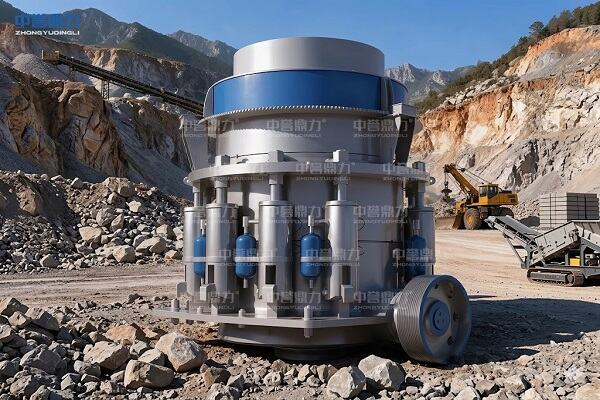
Cone crushers play a vital role in modern stone crushing and aggregate production lines. They are widely used in mining, quarrying, construction, and recycling industries because of their high efficiency, reliable performance, and ability to produce uniform particle sizes. In a complete crushing plant, cone crushers are commonly used for secondary, tertiary, or fine crushing stages after jaw crushers process large raw materials.
Understanding the working principle of a cone crusher helps operators improve productivity, reduce maintenance costs, and optimize plant performance.
What Is a Cone Crusher?
A cone crusher is a compression-type crushing machine designed to reduce materials by squeezing them between a moving cone and a stationary cone liner. It is especially suitable for crushing medium-hard to hard materials such as:
Granite
Basalt
River stone
Iron ore
Limestone
Quartz
Compared with other crushing equipment, cone crushers offer higher production capacity, better particle shape, and lower wear costs in many stone crushing applications.
Main Components of a Cone Crusher
To better understand the working principle, it is important to know the key components of a cone crusher.
Mantle
The mantle is the moving crushing surface mounted on the main shaft. It performs a swinging motion during operation.
Concave
The concave is the stationary outer liner fixed inside the upper frame of the crusher. Materials are crushed between the mantle and concave.
Main Shaft
The main shaft supports the mantle and transmits the crushing force generated by the eccentric mechanism.
Eccentric Sleeve
The eccentric sleeve drives the mantle to move in a circular motion, creating continuous compression and crushing action.
Hydraulic System
Modern cone crushers often use hydraulic systems for overload protection, discharge opening adjustment, and automatic cavity cleaning.
Drive System
The electric motor powers the crusher through pulleys, belts, and gears to maintain stable operation.
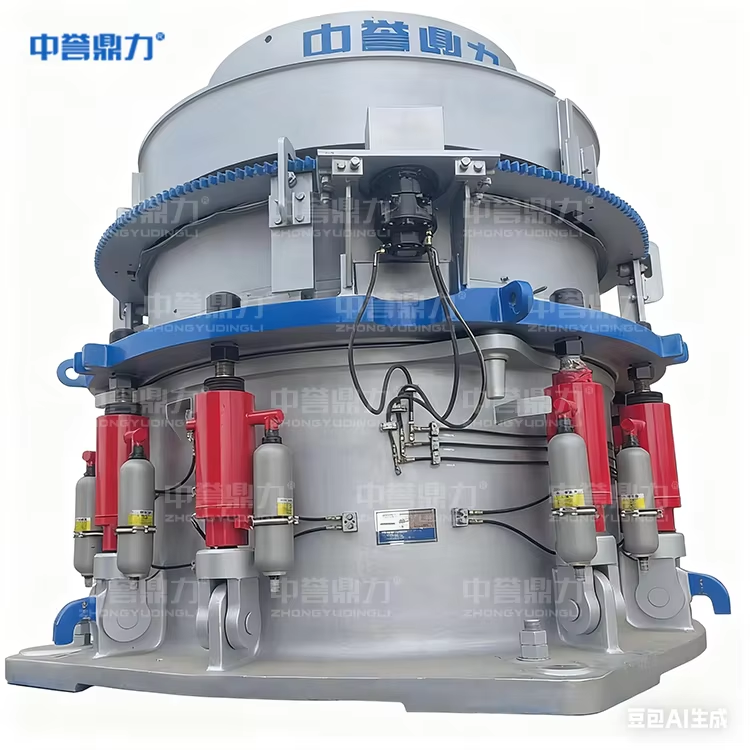
Cone Crusher Working Principle
The working principle of a cone crusher is based on the compression and squeezing of materials between moving and stationary crushing surfaces.
Material Feeding
Raw materials are fed into the crushing chamber from the top opening. Usually, vibrating feeders and conveyors deliver the material evenly into the crusher.
Uniform feeding is important because uneven feeding may reduce crushing efficiency and increase liner wear.
Eccentric Motion Begins
The motor drives the eccentric sleeve through the transmission system. As the eccentric sleeve rotates, the mantle performs a circular swinging motion around the main shaft.
This movement causes the distance between the mantle and concave to continuously change.
Material Compression and Crushing
When the mantle moves closer to the concave, the material between them is compressed and crushed. Large stones are gradually broken into smaller particles under strong pressure.
Because cone crushers use continuous compression crushing, they are highly efficient when processing hard and abrasive materials.
Material Falls Downward
After being crushed, the smaller material moves downward inside the crushing chamber due to gravity. The material continues to experience multiple crushing actions as it travels lower in the chamber.
This multi-layer crushing process helps produce a more uniform final product shape.
Discharge of Finished Material
Once the material reaches the desired size, it exits through the discharge opening at the bottom of the crusher.
Operators can adjust the discharge opening to control the final product size according to production requirements.
Applications of Cone Crushers
Cone crushers are commonly used in:
Aggregate production plants
Metal mining operations
Highway construction projects
Railway ballast production
Hydropower engineering
Construction waste recycling
In many stone crushing plants, cone crushers work together with jaw crushers, vibrating screens, sand-making machines, and intelligent control systems to achieve efficient and stable production.
Conclusion
Cone crushers are indispensable machines in modern stone crushing operations. Their working principle is based on continuous compression crushing between the mantle and concave, allowing efficient processing of hard materials and production of high-quality aggregates.
Understanding how cone crushers work can help operators optimize plant performance, improve product quality, and reduce operational costs.
With rich industry experience and advanced intelligent technologies, Zhongyu Dingli continues to provide high-performance crushing solutions and professional EPC services for customers around the world.